



Jihyun Lee Senior Editor | CIO
How an AI service platform is accelerating transformation at the South Korean energy and chemical company.

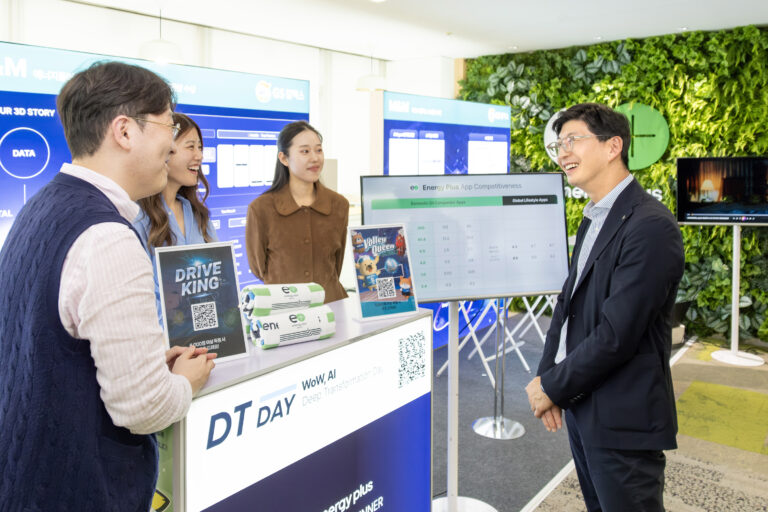
Caught between change and stability, many companies find themselves hesitating on how to square the two. The pace of change is increasing in the age of AI, and the weight of making inspired choices has only become more critical. GS Caltex, one of Korea’s leading refining companies, faced the same dilemma and recently embraced a new guiding principle of good risk taking — a phrase reportedly often heard in GS Caltex meetings, and initially proposed by company CEO Hur Sae-hong. “Once the word ‘good’ was added to ‘risk-taking,’ a culture began to spread where people are willing to attempt any challenge,” says CIO, CDO, and DX Center head Lee Eunjoo.
Amid growing uncertainties around crude oil prices and product demand, intensifying competition over production scale, and demographic decline, the value of good risk taking is pushing the company to pursue new opportunities and innovation. And a changing mindset is reshaping the organization from within.
The AI platform changing the enterprise
Even without any top-down mandate, it’s common at GS Caltex to see not just IT but LOB teams in production, sales, finance, legal, PR, and HR building and using AI agents in their day-to-day work. Finance, for instance, recently built an FAQ agent and asked Lee’s team to review it. “It’s incredibly rewarding to see employees actively using the new technologies provided by the DX Center.”
So far, they’ve created more than 50 agents, including ones that support pre-job safety briefings for partner company staff, review crude oil purchase contracts, automate a complex medical expense reimbursement process, and automatically classify and analyze gas station customer feedback.
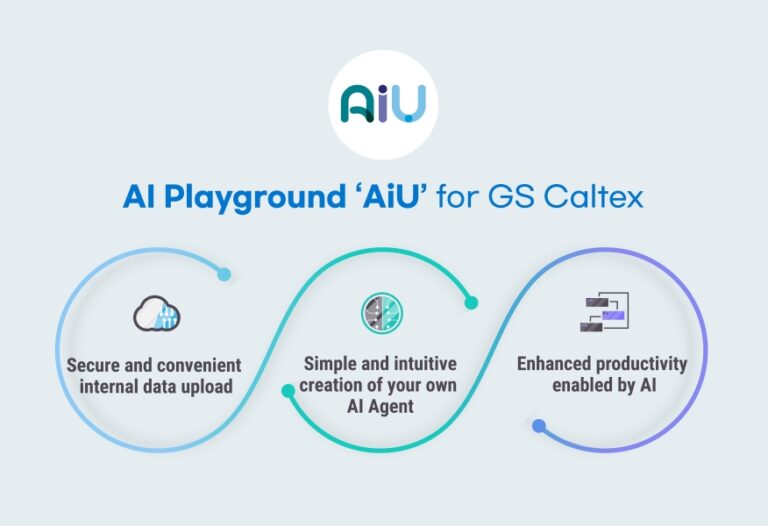
All of these agents were developed on AiU, the company’s in-house gen AI service platform launched in June this year, which combines AI with yu, the Korean word for oil, and is also a play on “AI for you,” reflecting its role as AI tailored to each employee.
Lee says AiU is the clearest expression of the company’s approach to transformation. “It’s not just about DX anymore but DAX, combining digital with AI transformation,” she says. “From our production sites to headquarters, we’re rolling out initiatives that let every employee experience it all side by side. That’s how we’re reshaping ourselves into an energy company that uses AI broadly and with confidence.”
A secret to its rapid success is because no one feels pressured to build a perfect agent. “People are much more willing to try things and experiment,” says Lee. From the DX Center’s standpoint, that mindset has made it possible to support a growing number of AI projects with a relatively small team. “Plus, the AiU playground lets employees build and test agents themselves, which makes AI feel far more approachable and familiar in their day-to-day work,” she adds.
An AI agent platform might sound like something only developers can use, but AiU is designed so non-experts can easily work with it. The experience isn’t very different from ChatGPT as GS Caltex deliberately embedded AiU into the side of core business systems that employees check every day, so they’d naturally encounter and use AI in their daily workflows. Even if they don’t build agents themselves, employees can still ask the AI questions using internal company data, and search across both external information and internal systems at once.
It’s only been a few months since AiU officially launched, and around 85% of employees are now regular users, and nearly the entire workforce has tried it at least once. “Most of our production and technical staff work in a mobile-only environment without desktops,” Lee says. “The fact 95% of them have already used AiU shows just how fast the platform is spreading.”
Sowing seeds of success
AiU drew strong interest from employees even during its pilot stage. The DX Center began discussing AI service adoption in 2023, and in 2024, the team built a pilot service on AWS in just a few days. Although it was an early version with only basic UI, more than 300 employees participated and shared the features and requirements they needed. This underscored just how many people were eager to bring AI into their work.
Through this pilot, the DX Center was able to clearly identify what kinds of problems employees wanted to solve with AI, and which capabilities they needed most. The team then considered whether to adopt an external solution or develop one in house. In the end, they chose to build on MISO, the AI transformation platform developed by the GS Group, and add GS Caltex–specific capabilities on top. The entire development took about six months.
In designing AiU’s technical architecture, Lee focused most heavily on minimizing dependence on any single LLM. The platform supports multiple models that employees can choose from, including OpenAI and Anthropic.
“AI moves incredibly fast, so we built the system in a way that lets us easily plug in better technologies as they come along,” she says. “The AI layer will keep changing, but the internal data and applications underneath it will remain our core assets, which is why we’ve focused on strengthening the underlying infrastructure. That’s where our DAX philosophy — advancing digital and AI transformation together — comes into play.”
But AiU has done more than speed up AI adoption. It’s also put new life into existing systems. GS Caltex already had an internal enterprise search platform, but over time, its accuracy and usability declined, and usage dropped. AiU stepped in to augment that system with AI. Employees can now search M365 documents, work rules, and HR information in one go, and have the results summarized for them by the AI.
“All we really did was layer AI on top of what we already had to make it a little easier to use,” Lee says. “But in the end, that AI layer ended up reviving a service that was close to being forgotten.”
The growth engines behind the projects
Rolling out and scaling new IT technologies like AI across an entire organization isn’t easy. It’s common to see transformation stall at the slogan stage, held back by resistance to new tools or the simple reality that people are too busy to change how they work.
GS Caltex, however, has avoided treating DX as a one-off initiative. Instead, the company has built three pillars to sustain company-wide change over the long term: culture, performance management, and education.
The first step was to build a bottom-up DX culture. Traditional IT projects often begin with large-scale planning, writing RFPs, and selecting external vendors — a process so long that customer needs frequently change before anything goes live.
GS Caltex chose a different path: a fast-execution model focused on solving customer needs in real time. Even a small app or a single dashboard is recognized as DX, and each attempt is treated as valuable. One example is an app that automatically collects and organizes external news, built by a frontline business team not the IT department.
As these small wins accumulated, a voluntary culture of digital innovation took root. Since the establishment of the DX Center in 2019, GS Caltex has carried out hundreds of projects this way.
Behind this transformation is a high level of organizational acceptance. No matter how well something is built, if colleagues don’t respond favorably, it doesn’t advance. That hasn’t been a problem at GS Caltex, though, largely due to the embedded good risk taking philosophy.
“DX inevitably involves a certain level of risk,” says Lee. “For good risk taking to really work, you need to understand the level of risk and have leaders actively backing it. We have that kind of culture in place.”
After joining GS Caltex, Lee learned a new approach to positive communication. Rather than focusing on fixing problems, the company emphasizes recognizing small achievements, celebrating them together, and then building on that foundation to find areas to improve. “I’ve personally experienced the value of a positive feedback culture,” she says. “A culture that openly recognizes achievements has become a natural driving force encouraging frontline employees to participate in DX.”
This philosophy has been embedded into reward and performance management systems, including a performance innovation committee, which selects outstanding DX projects initiated by business teams and presents awards. And presentations are delivered not by team leaders but by the frontline employees who actually led the work. The monthly selected cases are then published on the company’s internal website, making sure their contributions are visibly acknowledged.
These practices give other employees confidence to do the same, and thus fuels wider voluntary participation. The committee also actively shares failure cases. By openly discussing what was attempted in each project and what could be improved, the company aims to turn failure into an opportunity for learning.
Lee says that GS Caltex only recognizes outcomes that can be proven in financial terms. Common IT metrics such as conversion rates or click-through rates, often used as proxy indicators, aren’t treated as final measures of success. Instead, the company tracks more meaningful indicators such as productivity gains that drive innovation, cost reductions, and improvements in customer satisfaction. These results are all centrally managed through the company-wide performance management system.
But it’s education that the DX Center prioritizes most. Rather than relying on a small group of experts, GS Caltex has chosen a strategy of cultivating hundreds of frontline DX specialists and sees strong results. The more business-side DX experts there are who can use digital tools to directly solve on-site problems, the faster digital adoption spreads. So once technology takes hold in the field, the DX organization provides the necessary development environment and additional support.
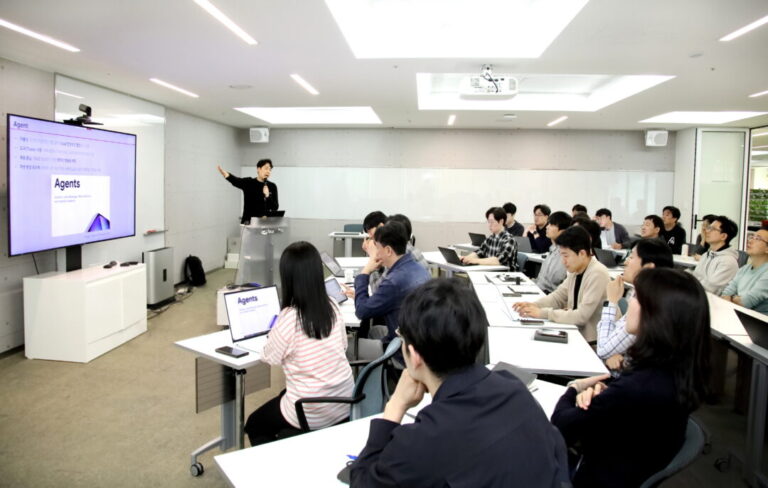
This training initiative, called the digital academy, runs as full-day programs ranging from a single day up to three months. It focuses on reskilling and deepening professional expertise to develop DX talent. The curriculum includes low-code developer tracks and in-house DX expert courses, enabling frontline employees to learn technologies themselves and apply them directly to their work. Topics include RPA, Tableau, Python, AI, and data science. Most notably in recent months, every executive has gone through gen AI training themselves, setting the tone from the top and actively championing a culture of continuous learning.
From IT support to proactive DX engine
Two years into her tenure, Lee is now reimagining how DX governance works. Historically, the DX organization operated in reactive mode, fielding requests from business units as they came in. Now, it’s flipping the script. That means taking the lead on company-wide DX priorities, vetting technologies for maturity and feasibility, and consolidating redundant projects.
One clear target is to streamline the system portfolio. Lee also plans to retire underutilized systems and those where operating costs outweigh the value they deliver, cutting waste while boosting efficiency.
At the same time, GS Caltex is leaning into global outsourcing. The company is building a distributed operations model, partnering with offshore teams not just for IT infrastructure, but for internal systems spanning HR, procurement, legal, and beyond. The savings are being funneled back into critical areas, like bolstering disaster recovery capabilities to strengthen business continuity, and reinforcing the DX foundation to deliver more reliable support across the organization.
AI, of course, remains a top priority, and internal demand is surging. “Employees, especially senior leaders, want services that pull together even more data,” Lee says. “Down the road, I’d like AiU to evolve to the point where you can ask what’s been happening with a particular customer lately, and instantly get a unified view of what division A is working on, what division B needs, and live customer inquiries all in one snapshot.”